
Choosing an Indoor Trampoline Supplier requires more than comparing prices, photos, and production capacity. Global buyers must examine frame steel, welding quality, spring protection, foam density, net strength, and installation guidance. A bright showroom can hide weak details.
Jeff Platt, a recognized trampoline-park industry leader and former Sky Zone executive, once emphasized, “Safety is not a feature; it is the foundation of the experience.” This principle remains practical for commercial buyers. A dependable supplier should explain testing methods, load limits, inspection routines, replacement parts, and staff training. Certificates matter, but certificates alone are not enough. Factory audits, sample testing, and clear technical drawings reveal more.
This guide reviews China’s top ten Indoor Trampoline Supplier candidates for international purchasing teams. It considers manufacturing experience, material consistency, customization ability, communication, export support, and after-sales service. Some suppliers may offer impressive designs but limited documentation. Others may provide strong engineering while needing better delivery coordination. That difference matters.
Buyers should request recent project references, independent test reports, and detailed quotations. They should also confirm applicable standards in the destination market. A low initial price may become expensive after redesigns, missing parts, or installation delays. I have seen supplier comparisons focus heavily on appearance. That is understandable, yet incomplete.
The strongest choice balances safety, durability, service, and realistic budgeting. No ranking can replace due diligence. Small oversights can become large operational problems. This article aims to make those decisions clearer, while recognizing that supplier performance can change over time.
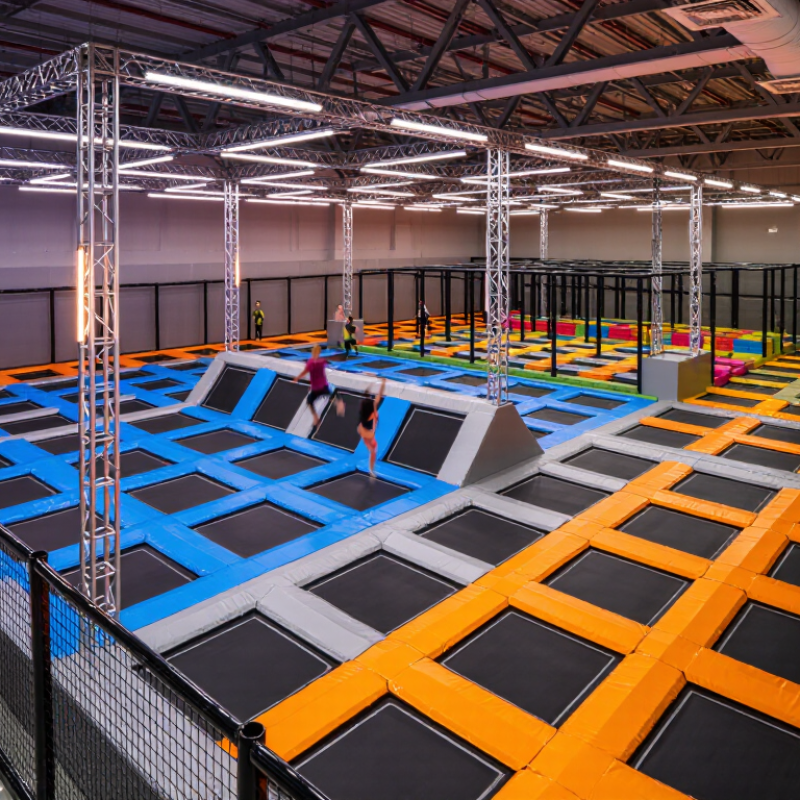
A leading indoor trampoline supplier in China is defined by more than factory scale or attractive pricing. It must understand visitor flow, impact zones, cleaning routines, and daily maintenance.
IAAPA’s 2024 Global Economic Impact Study reported that the global attractions industry supported 24.5 million jobs and generated about $1.2 trillion in economic activity during 2023. This growth increases pressure on suppliers to deliver safer, longer-lasting equipment.
Engineering evidence matters.
A reliable supplier should design courts around ASTM F2970 requirements, including padding, anchoring, clearance, inspection, and operating procedures. It should provide load calculations, material specifications, test records, installation drawings, and replacement-part schedules.
ISO 9001 certification can support process control, but it does not prove product safety alone. Independent testing remains valuable. Ask for recent reports, not only factory photographs.
Experience appears in small details.
Rails should feel stable under repeated movement. Foam blocks should recover their shape after heavy use. Welds need smooth finishing, especially near climbing areas.
A capable supplier also trains installers and responds quickly when a spring, mat, or connector fails. No factory is flawless. That is worth admitting.
Some suppliers still rely on generic layouts or optimistic service promises. Buyers should inspect a completed venue, review maintenance records, and test communication before placing a large order. Cost matters, but weak documentation can become an expensive operational problem.

China Top 10 Indoor Trampoline Suppliers for Global Buyers
The top ten suppliers are selected through practical buyer-focused checks, not online rankings alone. Our review considers manufacturing experience, product consistency, safety systems, and export performance. Factory visits can reveal details that brochures often hide. We inspect welding points, spring protection, foam density, and surface stitching. Sample units are tested for frame stability, repeated jumping, and impact absorption. Small defects matter.
Technical documents must match the actual product. We examine material certificates, inspection reports, installation guides, and maintenance instructions. Suppliers with clear traceability receive stronger consideration. Independent testing is valuable when it covers structural strength, padding, fire behavior, and user safety. Compliance claims without supporting records are not enough. Buyers should request updated documents for every major design change.
Reliability also depends on communication after shipment. We assess response times, spare-part access, packaging quality, and installation support. Production capacity matters, but rapid output can create pressure on quality control. This is often overlooked. No supplier is flawless, and a polished showroom cannot prove long-term performance. We compare factory evidence with customer feedback, then record both strengths and weaknesses. A supplier may offer competitive prices yet lack consistent inspection records. Another may communicate well but need better engineering documentation. These imperfections remain part of a responsible selection process.
This chart presents a practical selection framework for global buyers. The 100-point weighting emphasizes product safety and quality control, while also considering export capability, production capacity, customization, and after-sales support. It is an evaluation model rather than a ranking of individual companies.
Key references for buyer assessment include applicable EN 71, ASTM F381, ISO 9001, and CPSIA compliance requirements, depending on the destination market and product category.
China’s indoor trampoline industry includes manufacturers with different strengths, production scales, and export experience.
This profile examines ten leading supplier types serving global buyers. Some focus on compact family entertainment centers, while others build large commercial parks with climbing walls, foam pits, and obstacle zones.
Several suppliers offer complete design support, including layout drawings, equipment selection, installation guidance, and staff training. Their factories commonly use galvanized steel frames, reinforced padding, heavy-duty springs, and flame-resistant materials.
Buyers should request material certificates, load tests, welding records, and inspection photos.
A factory visit can reveal more than a polished catalog. Details matter.
Some suppliers specialize in custom colors and themed interiors. Others provide faster production through standardized modules. Export-ready teams often understand packaging, container loading, spare parts, and technical documentation.
Still, communication quality varies. A supplier may promise flexible customization but struggle with late design changes. No supplier is perfect.
Buyers should compare warranty terms, replacement procedures, production samples, and after-sales response times before signing contracts.
The strongest profiles show practical experience rather than attractive product images alone.
Look for completed projects, clear safety procedures, and transparent quality checkpoints. Ask how installers handle uneven floors, ceiling limits, and emergency access.
These questions expose useful differences between suppliers.
A careful review may take longer, but it reduces expensive surprises during installation and daily operation.
China Top 10 Indoor Trampoline Suppliers for Global Buyers
Comparing products, certifications, prices, and customization options reveals major differences among Chinese suppliers. Grand View Research estimates the global trampoline park market will grow at roughly 10% annually through 2030. Buyers should therefore assess long-term safety, not only factory price. Commercial systems may include interconnected trampolines, foam pits, climbing walls, and impact-protection padding. Ask for load tests, material specifications, replacement procedures, and installation drawings. A low quote can become expensive when spare parts are unavailable.
Certification needs careful checking. ASTM F2970 covers trampoline courts and related operational safety requirements in the United States. EN 1176 may apply to certain play structures in European projects, but it does not replace product-specific risk assessment. Request current test reports, factory quality records, and certificates matching the exact model. Verify the issuing laboratory independently. A certificate alone proves little.
Indicative China export quotations often range from about 180 to 500 US dollars per square meter, depending on steel grade, padding density, attractions, packaging, and installation support. Custom colors, logos, floor plans, and themed panels can raise costs by 10% to 30%. Intertek’s 2024 global consumer product outlook highlights continuing pressure on traceability and supply-chain assurance. That matters here. My practical concern is simple: many comparisons ignore maintenance. Buyers should calculate annual inspections, mat replacement, shipping, duties, and technician visits. I would also request a small material sample before approving a full production run.
| Rank | Anonymous Supplier Profile | Main Indoor Trampoline Products | Typical Project Size | Structural and Safety Features | Common Certification Documentation | Indicative Factory Price | MOQ and Lead Time | Customization Options | Best Fit for Global Buyers |
|---|---|---|---|---|---|---|---|---|---|
| 1 | Supplier Profile 01 | Large indoor parks Ninja courses Climbing walls | 300–2,000 m² complete projects | Galvanized steel frame, 1.2–1.5 m safety padding, PVC-coated foam protection, modular anchor system | EN 1176 test support ASTM F2970 test support ISO 9001 available | US$180–420/m² | Project-based; 35–55 days after approved drawings | Layout design, color schemes, obstacle mix, logos, safety signage, export packaging | Turnkey family entertainment centers and indoor adventure parks |
| 2 | Supplier Profile 02 | Wall-to-wall trampolines Dodgeball courts Basketball zones | 150–1,200 m² | High-tensile springs, multilayer jump mats, closed-cell foam pads, netted separation barriers | CE component documentation EN 1176 review support Material test reports | US$160–350/m² | MOQ normally 100 m²; 30–45 days | Court dimensions, mat colors, printed graphics, access gates, sports accessories | Sports centers, recreational venues, and medium-sized trampoline parks |
| 3 | Supplier Profile 03 | Toddler areas Soft-play trampolines Mini jump platforms | 50–500 m² | Low-height platforms, soft edges, low-tension mats, padded posts, enclosed toddler circulation areas | EN 71 material test support EN 1176 consultation Phthalate test reports | US$190–460/m² | MOQ 1 customized set; 25–40 days | Theme graphics, age zoning, soft-play integration, custom colors, educational panels | Shopping malls, childcare venues, and family activity centers |
| 4 | Supplier Profile 04 | Freestanding trampolines Commercial jump units Portable modules | Individual units from 3 to 25 m² | Powder-coated steel frames, replaceable spring systems, UV-resistant padding, adjustable feet | CE declaration support EN 13219 reference testing Load test reports | US$650–3,800/unit | MOQ 5 units; 20–35 days | Frame dimensions, mat artwork, pad colors, wheel kits, spare-part packages | Hotels, resorts, gyms, schools, and mobile event operators |
| 5 | Supplier Profile 05 | Premium trampoline parks Performance zones Training areas | 250–1,500 m² | Heavy-duty steel construction, reinforced corner modules, high-density foam, impact-rated netting | ASTM F2970 test support EN 1176 documentation Welding inspection records | US$220–480/m² | Project-based; 40–60 days | Performance lanes, landing zones, branded wall panels, lighting coordination, CAD drawings | High-traffic venues requiring durable commercial equipment |
| 6 | Supplier Profile 06 | Compact park systems Interactive jump games Party areas | 80–600 m² | Modular galvanized frames, replaceable pads, anti-slip flooring, optional LED and sensor systems | CE electrical documentation RoHS component reports EN 1176 review support | US$175–390/m² | MOQ 80 m²; 30–50 days | Interactive software integration, LED colors, floor graphics, game layouts, multilingual signs | Urban entertainment centers and venues with limited floor space |
| 7 | Supplier Profile 07 | Ninja warrior systems Airbag landing zones Trampoline tracks | 120–900 m² | Reinforced frames, modular obstacles, impact-absorbing airbags, climbing and balance elements | EN 1176 risk-assessment support PVC material reports Inflatable air-leak testing | US$200–450/m² | MOQ 1 project; 35–55 days | Obstacle difficulty, course length, custom branding, airbag colors, coaching platforms | Adventure parks, training facilities, and youth activity venues |
| 8 | Supplier Profile 08 | Budget modular parks Basic jump courts Replacement components | 60–400 m² | Standard steel modules, foam edge protection, commercial jump mats, replaceable spring assemblies | CE declaration support Material safety reports Basic load testing | US$120–280/m² | MOQ 50 m²; 20–35 days | Standard color selection, panel graphics, basic layout changes, spare parts, packaging upgrades | Start-up operators and buyers with strict project budgets |
| 9 | Supplier Profile 09 | Export-ready park packages Multi-zone systems Soft-play combinations | 200–1,000 m² | Modular steel structure, fire-retardant padding options, net barriers, marked emergency routes | EN 1176 documentation ASTM F2970 review support Fire-retardancy reports | US$170–400/m² | MOQ 100 m²; 35–50 days | One-stop layout, soft-play additions, country-specific labels, carton markings, installation manuals | Importers and distributors serving several international markets |
| 10 | Supplier Profile 10 | Custom architectural parks Themed interiors Mixed attraction zones | 400–3,000 m² | Engineered steel framework, custom platforms, integrated barriers, impact flooring, ventilation planning | Structural calculation package EN 1176 consultation ISO 9001 available | US$250–600/m² | Project-based; 50–75 days | Architectural concept, themed fabrication, 3D renderings, lighting coordination, installation supervision | Large flagship venues, developers, and international project contractors |
Global buyers should evaluate Chinese trampoline suppliers beyond attractive catalogs. Grand View Research valued the global amusement parks market at about USD 55.5 billion in 2023. This growth increases supplier choices, but also creates uneven quality. Request factory photos, production records, material specifications, and recent inspection reports. A video call should show welding areas, foam pits, anchor points, and packaging details. Do not rely on edited videos alone.
Ask for a sample module before placing a full order. Check steel thickness, spring protection, PVC stitching, foam density, and platform stability. ISO 23659:2022 provides safety requirements for trampoline parks, while relevant ASTM guidance can support additional testing. Your purchase contract should define tolerances, replacement parts, loading limits, delivery terms, and inspection procedures. A low quotation may hide weaker steel or incomplete installation support.
Tips: Compare at least three suppliers using the same checklist. Confirm whether testing covers the complete system, not one component. Ask for references from similar climates and facility sizes. Inspect cartons for moisture barriers and corner protection. A polished catalog is not proof. I would also budget for independent pre-shipment inspection; skipping it often feels efficient, but it can become an expensive mistake. Allow time for drawings and revisions. Many buyers rush this stage. They should not.
© 2022-2025 Pelican Lakes Resort & Golf, All rights reserved | Privacy Policy
BROUGHT TO YOU BY THE WATER VALLEY COMPANY